QG30

QG40 / QG40N

QG65 / QG65N
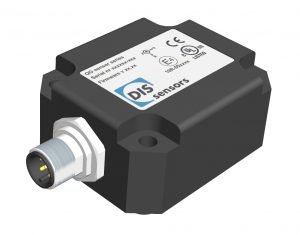

QG76 / QG76N
How Does an Inclinometer Work?
An inclinometer is used in situations where accurate positioning or constant monitoring of the angle in relation to gravitational pull is essential. It measures the angle with respect to a horizontal position, whereby an imaginary line from the center of the earth serves as a reference.
Easy to Mount
An inclinometer has a very wide range of applications since it can be mounted anywhere and offers flexibility in mechanical design. The sensor output has two components: a static (slope) component and a dynamic (acceleration) component. The sensor output is always a combination of these two components. The inclinometers from DIS have a standard bandwidth of 10 Hz, although it is possible to reduce this bandwidth further at the client’s request.
Functions
Leveling, tilt protection, roll and pitch measurement, and angle measurement.
Types
DIS Sensors inclinometers are available with the following general specifications:
| Single axis measurement range: | ±10°; ±30°; ±90°; 0 – 360° |
| Double axis measurement range: | ±10°; ±30°; ±90° |
| Analog output: | 0.5 – 4.5 V or 4 – 20 mA |
| Digital output: | CANopen (Safety); RS232 |
| Level of protection: | IP67 (optional IP68 of IP69K) |
| Programmable: | Filtering, measuring range |
| Zeroing possibility: | Depends on model |
| Functional safety: | SIL2/PLd (optional) |
| Housing: | (Reinforced) plastic or stainless steel |
Find the inclinometer you are looking for with the DIS Sensors Product Selector.