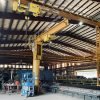
One of the biggest challenges in fully outdoor facilities is maintaining accurate and repeatable distance measurements for no-fly zone systems, while accounting for environmental factors like direct sunlight, airborne dust, dense steam, and high heat conditions. All of these are very prevalent in steel mills and heavy manufacturing sites.
Addressing this challenge head-on, Laser-View Technologies recently finished the design and commissioning of a Crane Sentry® Zone Manager II upgrade at an outdoor steel facility, using radar on the bridge axis and laser on the trolley axis.


Some of the considerations that pointed us towards adding radar functionality to our no-fly zone systems:
- Direct sunlight: Radar doesn’t rely on optical conditions, so direct sunlight on a fully outdoors runway isn’t part of the measurement. This was the primary driver for this project.
- Dust and airborne particles: Steel, cement, and/or mining environments put a lot of particulates in the air. Millimeter-wave radar generally holds up better than optical distance sensing methods.
- Sensor face contamination: Radar heads tolerate surface dust and dirt considerably better than optical sensors, which affects how often the sensors need maintenance.
- No reflective target to maintain: The system uses two radar heads measuring to each other. This eliminates the requirements for specific target orientation, shading requirements, and alignment corrections. It allows for accurate measurements up to very long distances when required.

Our laser distance sensors remain useful in plenty of applications. For example, they handle trolley axis on this overhead crane flawlessly. But pivoting in sensing methods is sometimes required depending on environmental and operational conditions.
The Crane Sentry® line of systems offers a modular approach to safety solutions, so every system can be tailored to your specific site needs.
If you’re working through crane positioning, no-fly-zone, and/or collision avoidance projects in outdoor conditions, we’re happy to talk! Email [email protected] today to get started.